Work & Case Studies

Show the reasoning, not just the deliverable.

These projects are built to show what Measured Resolve's work looks like in practice. Each uses a fictional organization and synthetic data to recreate the ambiguity, tradeoffs, imperfect information, and decisions that exist in real business problems.

The goal is not to manufacture impressive outcomes. It is to make the reasoning, analysis, deliverables, and limitations visible enough to inspect.

Flagship demonstration 01

In development

Fieldstone Commercial Services

The business question

Sales and workload were increasing, but leadership felt the business was not getting healthier. What was actually happening, where should they intervene first, and what evidence would show whether the intervention was helping?

A growing business felt less healthy. The data told a more complicated story.

Fieldstone Commercial Services is a fictional 24-person field-service company created to demonstrate a full Measured Resolve engagement. The project begins with accounting, scheduling, time, and operational records that do not naturally tell one clean story.

The initial concern was partly wrong. The 2024-2025 baseline showed that the modeled aggregate operating result improved. At the same time, direct contribution margins narrowed and original-promise delivery reliability deteriorated. That changed the question worth investigating.

All organizations, records, and outcomes in this demonstration are fictional and use synthetic data. No confidential client work is used.

The engagement path

Concern. Evidence. Finding. Investigation. Action.

The project is intentionally built as a sequence. We do not jump from a vague concern to a dashboard or recommendation before establishing what the records can support.

01

Check whether the evidence can support the question

Data Reliability Assessment

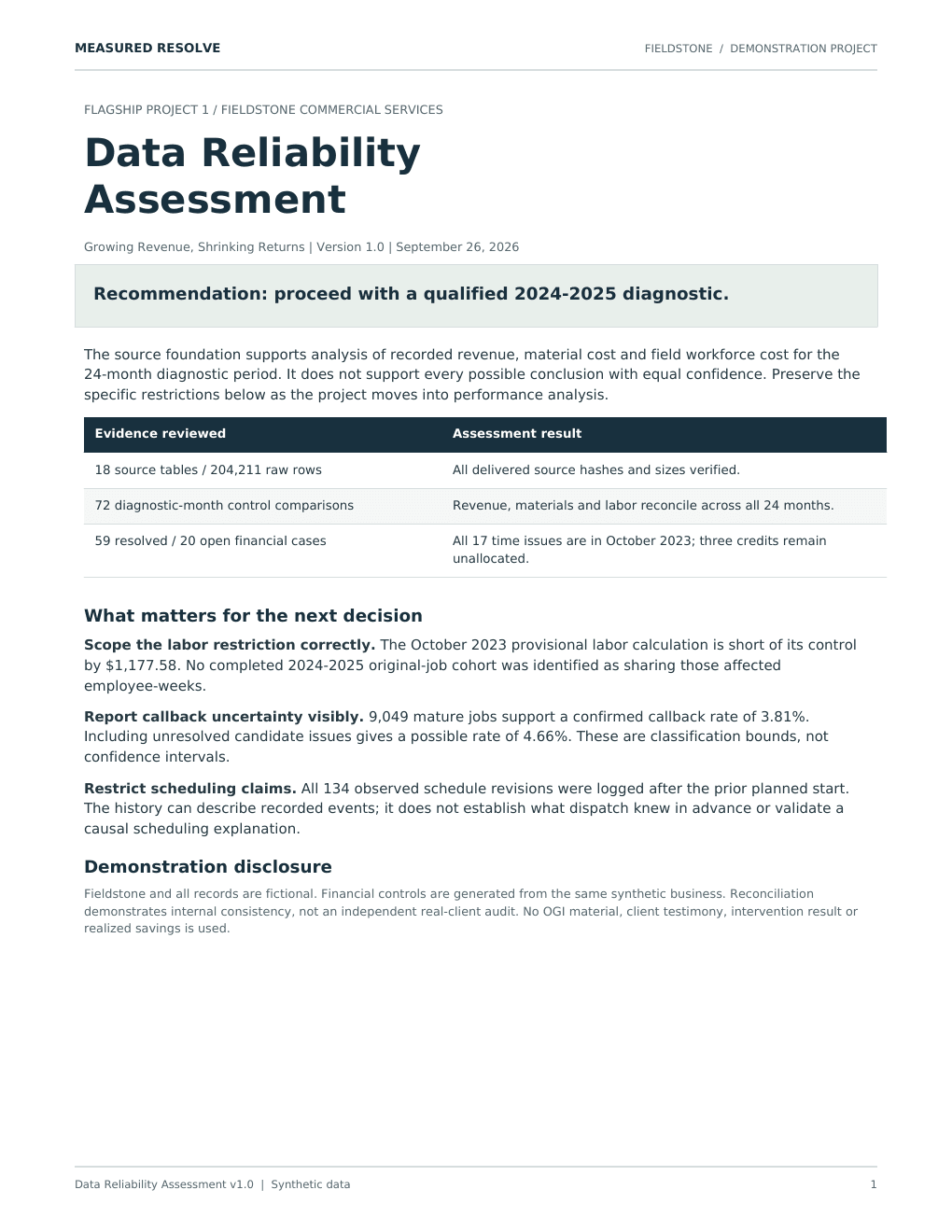
Before interpreting performance, we checked source coverage, reconciled financial controls, documented data limitations, and defined which questions the records could support responsibly.
02

Establish what is actually happening

Business Performance Diagnostic

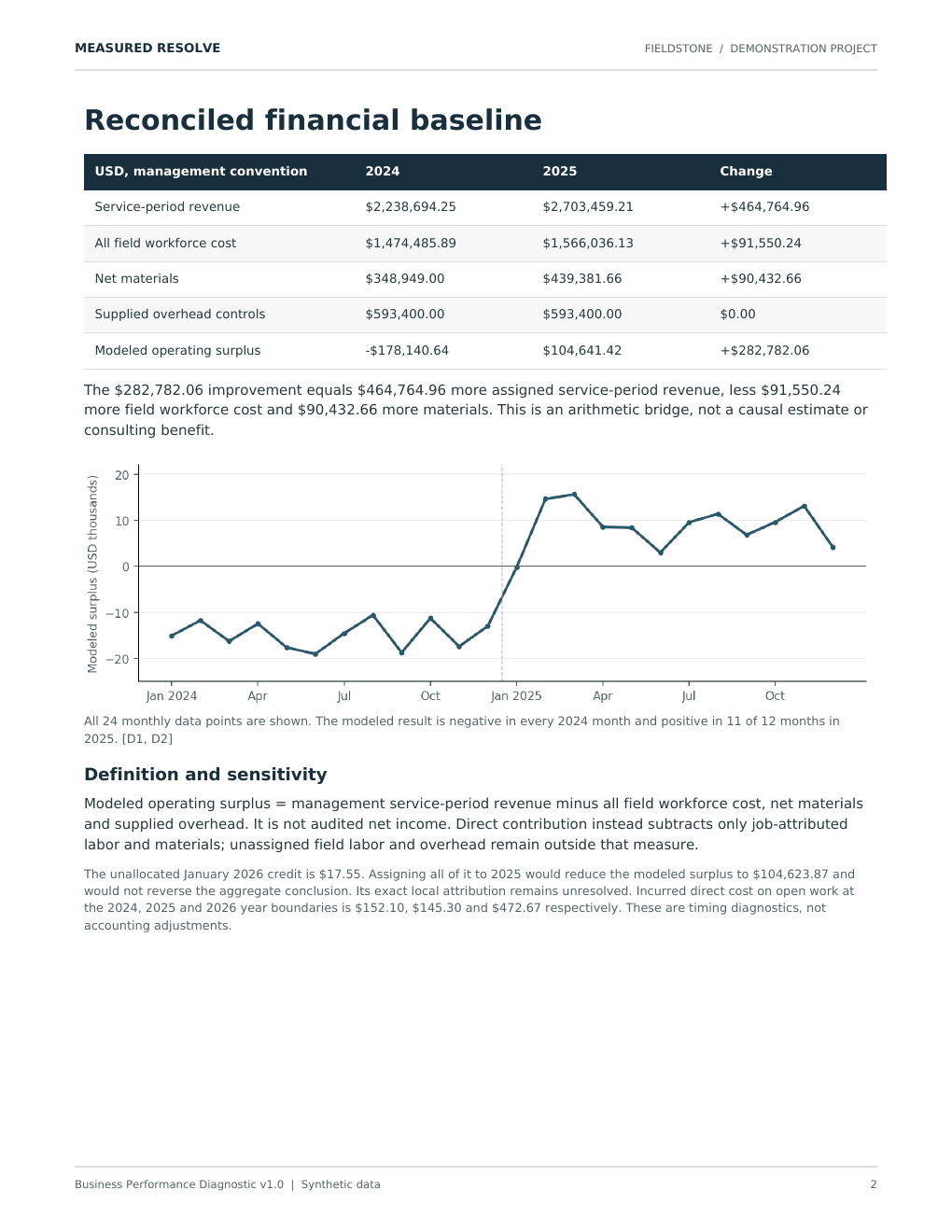
The diagnostic tested the starting concern instead of assuming it was correct. It established the financial and operational baseline, separated competing measures, and identified the problem that deserved deeper investigation.

03

Investigate the material problem

Root Cause Analysis

We traced missed completion promises through the operating sequence, compared competing explanations, documented what the records could and could not establish, and designed a focused intervention to test next.

04

Turn the finding into something usable

Promise Feasibility & Exception Management Prototype

The recommendation became a working prototype for capturing planned execution earlier, reviewing exceptions, recording decisions, and measuring whether the proposed control improves visibility and outcomes.

What the evidence showed

The useful finding was not the most dramatic one.

The numbers matter because of what they changed about the decision. Each finding below narrowed the problem, challenged an assumption, or identified where deeper investigation was justified.

24

months reconciled

Revenue, materials, and field-workforce controls were reconciled across the full 2024-2025 diagnostic period before headline conclusions were used.

1.60 pts

direct-margin decline

Direct contribution margin fell from 58.21% to 56.61%, even while the modeled aggregate operating result improved.

2.20 pts

on-time completion decline

Original-promise on-time completion fell from 98.08% to 95.88%, creating a clearer operational question than the original profit concern.

71.4%

of the increase traced to one pathway

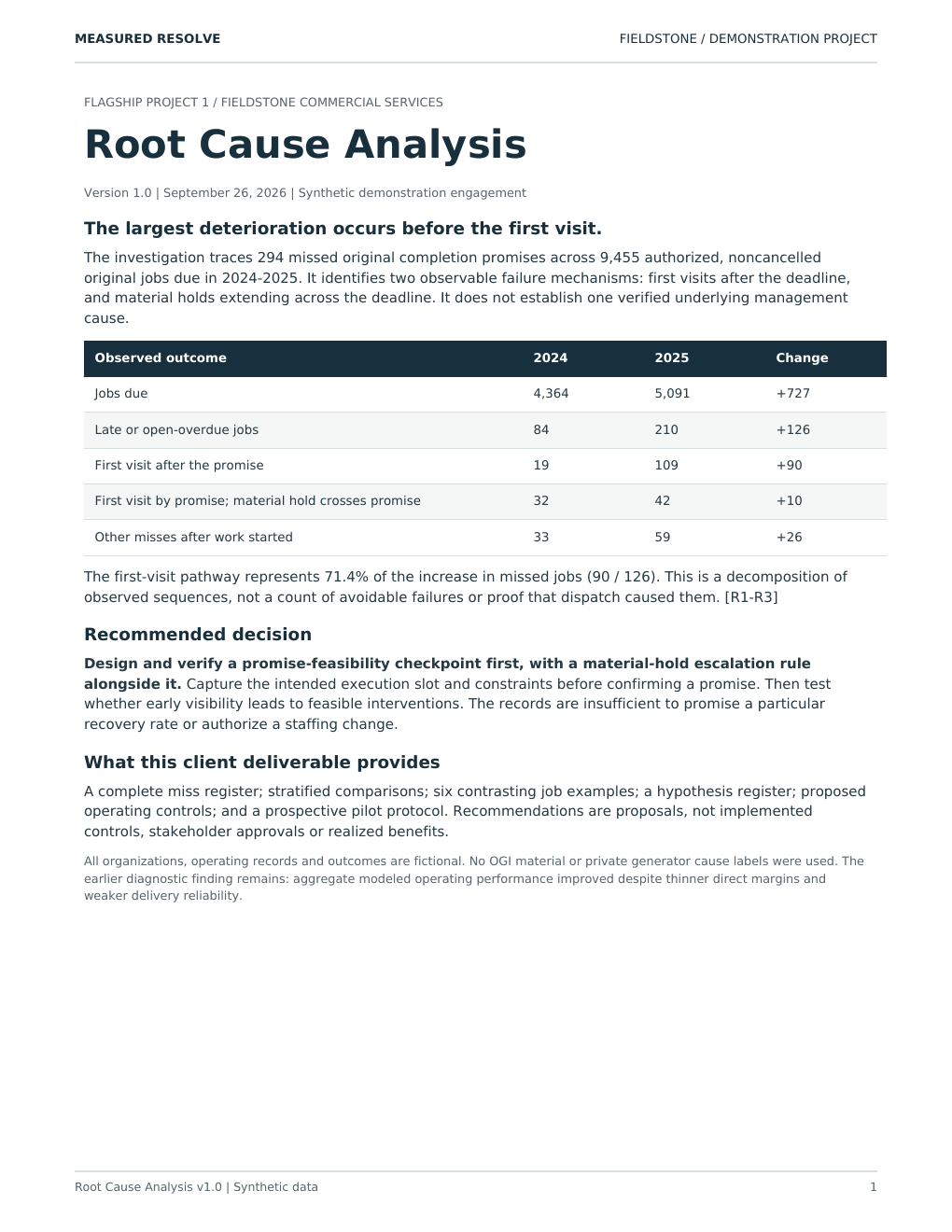
First visits occurring after the original deadline accounted for 90 of the 126 additional misses. That identified where deterioration occurred, not why it occurred.

What changed

Instead of trying to explain why growth was supposedly making the business less profitable, the investigation shifted toward a more supportable question: why was original-promise delivery reliability deteriorating as the business handled more work?

Deliverable preview

The work should be inspectable, not just described.

These are working artifacts from the Fieldstone demonstration. The finished case study will feature a smaller set of the strongest pages and interface views once the project is complete.

Data Reliability Assessment preview from the Fieldstone demonstration project

Data Reliability Assessment

Source coverage, reconciliation, restrictions, and what could proceed safely.

Business Performance Diagnostic preview from the Fieldstone demonstration project

Business Performance Diagnostic

A reconciled baseline that tested the original story rather than confirming it by default.

Root Cause Analysis preview from the Fieldstone demonstration project

Root Cause Analysis

Observed failure pathways, competing hypotheses, proposed controls, and an evaluation plan.

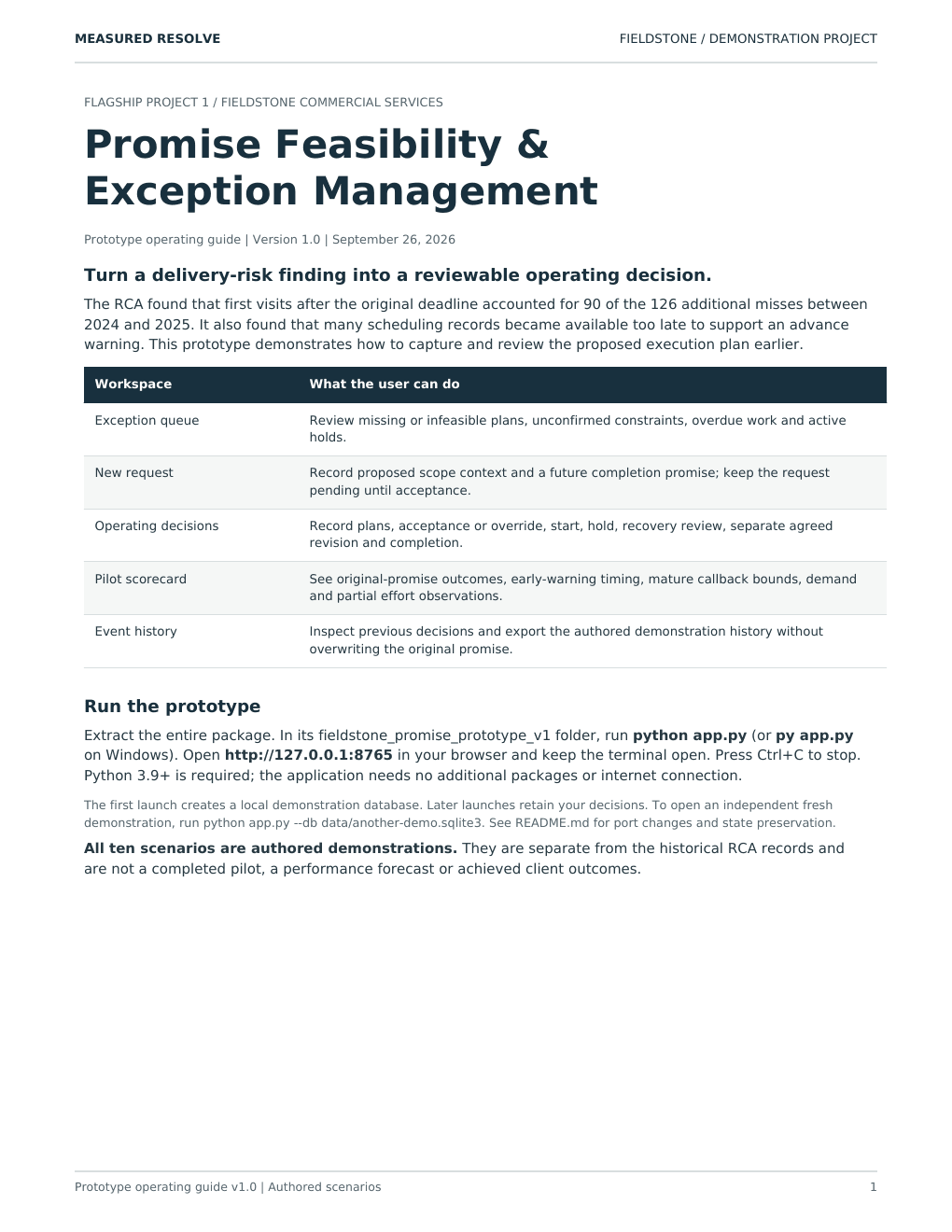
Operating Prototype preview from the Fieldstone demonstration project

Operating Prototype

A practical workflow for promise feasibility, exception review, decision capture, and pilot measurement.

From finding to action

The recommendation became something the business could actually test.

The Root Cause Analysis found that first visits occurring after the original completion promise accounted for most of the increase in misses. The records did not establish a single underlying management cause, so the recommendation was not a staffing change or a blanket process overhaul.

Instead, the proposed next step was a promise-feasibility checkpoint with a material-hold escalation rule. The prototype turns that recommendation into an operating workflow for reviewing exceptions before they become missed promises.

Exception queueRequest captureDecision historyPilot scorecardHold & recovery review

Evidence before assumption

What we resisted claiming.

A useful case study should show where the evidence changed the story, not quietly remove the inconvenient parts. These limits are part of the work, not footnotes to hide.

01

Growth did not reduce the modeled aggregate result

The starting concern suggested that a busier business might be earning less. The reconciled baseline did not support that conclusion. Revenue increased and the modeled operating result improved, even as direct margins narrowed.

02

Overtime was not declared the primary cause

Overtime appeared in the operating picture, but the evidence did not support treating it as the single explanation for weaker returns or delivery reliability.

03

Callback deterioration remained uncertain

The available records supported bounded callback estimates, not a clean claim that callbacks had conclusively worsened. That uncertainty stayed visible in the analysis.

04

An observed pathway is not the same as a proven cause

Late first visits explained much of the increase in missed promises, but that did not prove dispatch caused the misses or that every miss was avoidable.

Demonstration standard

Synthetic business. Real analytical standards.

These projects use fictional organizations and synthetic records so the full reasoning process can be shown without exposing confidential client information. The analytical standards are not fictional.

Findings still have to be supported by the generated evidence. Limitations stay visible. Modeled outcomes are not presented as achieved client results, and recommendations are not described as successful interventions unless they have actually been tested.

More work in development

The portfolio will grow when the work is ready to show.

Flagship demonstration 02

In development. It will be added once the analysis and client-facing deliverables are complete enough to inspect.

Flagship demonstration 03

Planned. The goal is to expand the portfolio across different business questions without filling the page with unfinished concepts.

Start a conversation

Have a problem that does not arrive with a clean explanation?

That is usually where the work begins. Tell us what you are seeing, what you have already tried, and what decision needs to become clearer.

Start a Conversation